Sam’s Garage
Classic truck restoration · 20 videos analyzed
Positioning
A one-man restoration channel: old trucks pulled out of barns and brought back to running order, with Sam doing the work on camera. Every video asks the same question: will this one run again?
Each thumbnail uses a different light: warm barn, white workshop, blue night. Two of the three put their title’s words on the image; the third has no text at all.
Evidence board
What is literally on each thumbnail. Facts first; every reading of them is a hypothesis.
- videos examined
- 3videos examined
- observations recorded
- 15observations recorded
- experiments proposed
- 2experiments proposed
Barn Find: Will This 1972 Truck Run Again?
Observed
- No text on the image
- Two subjects: Sam in the left third, the truck across the right two-thirds
- Sam’s face is about 2% of the frame, looking at the camera
- Warm, golden light with sun rays through the barn boards
- None of the title’s 8 words appears on the image
Hypothesis, unproven until tested
With no text and a calm, posed frame, the image may read as a portrait of a man and his truck. The question the video asks (will it run?) could be living in the title alone.
I Rebuilt This Engine in 48 Hours
Observed
- 2 words of text on the image (“48 HOURS”), yellow, top left
- The text repeats 2 of the title’s 7 words
- Five things to look at: the text, a red arrow, the engine, Sam, a workbench full of parts
- Sam’s face is about 5% of the frame, on the right edge
- Cool white workshop light; tools and a second truck fill the background
Hypothesis, unproven until tested
With five things of similar weight, the eye may have no clear first stop at phone size, and “48 HOURS” says again what the title already says instead of adding a second idea.
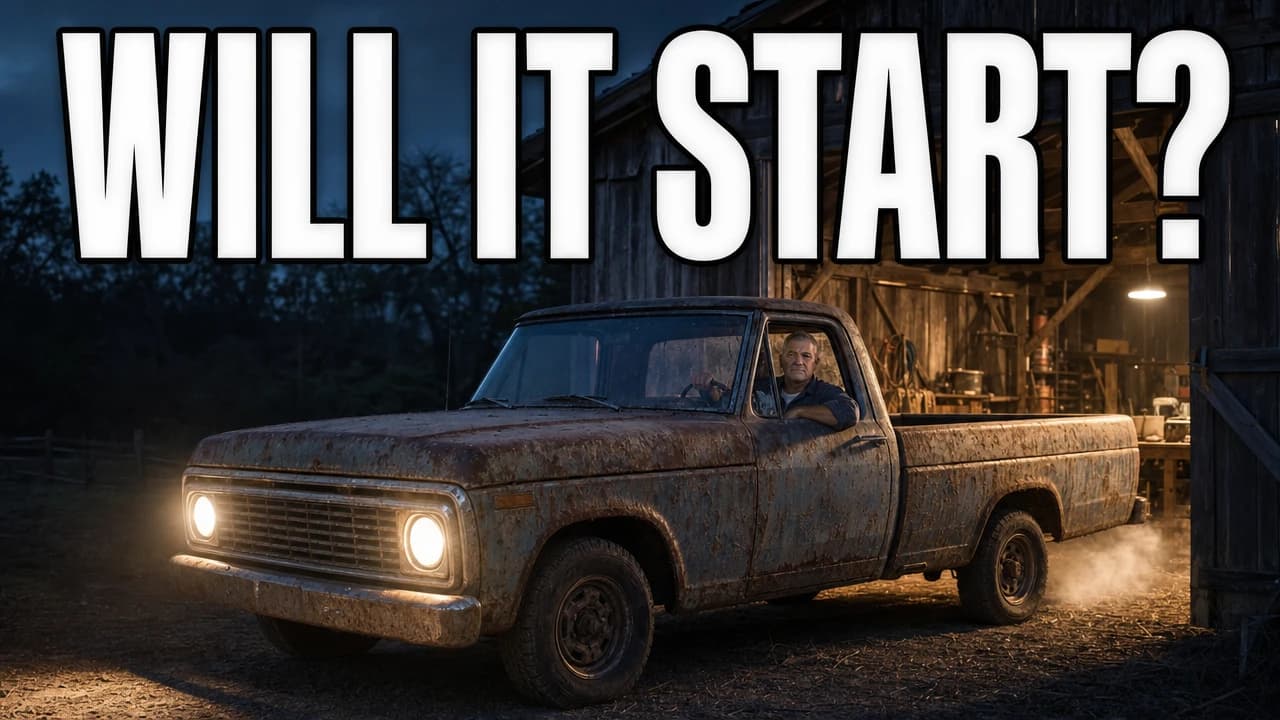
Will It Start After 30 Years in a Barn?
Observed
- 3 words of text on the image (“WILL IT START?”), white with a black outline
- The text repeats the first 3 of the title’s 9 words
- The text is the largest element: about the top third of the frame
- Sam is at the wheel, seen through the side window; his face is under 1% of the frame
- Dark blue night light: the only night scene of the three
Hypothesis, unproven until tested
The question is impossible to miss, but at phone size the text may crowd the truck, which is what a viewer wants to see. The blue night light may also not look like the same channel as the other two.
Experiments to run
In order. Each one is a single change you can prove or disprove.
Experiment 1: Let the image add a second idea
Hypothesis
If the words on the image say something the title doesn’t, the pair may tell a viewer two things in one glance instead of one thing twice.
Variant brief
Thumbnail: Keep the engine photo but crop in until the engine fills about 40% of the frame. Remove the arrow and most of the workbench. Replace “48 HOURS” with two words the title doesn’t use, such as “SEIZED SOLID”.
How to measure: YouTube Test & Compare, 2 variants (current and new), run until at least 5,000 impressions per variant.
Affected videosExperiment 2: One look across the channel
Hypothesis
If every thumbnail shares one kind of light and one text style, the videos may be easier to recognise as one channel when they sit next to each other.
Variant brief
Thumbnail: Redo “Will it start?” in the warm light of the barn-find thumbnail. Set the text in the same yellow as “48 HOURS”, at about half its current width, so the truck and its headlights stay visible.
How to measure: YouTube Test & Compare, 2 variants, at least 5,000 impressions per variant. Then look at the channel page as a whole.
Affected videos
Swipe file
Packaging worth studying in your niche. Reference material, not a scoreboard.
Abandoned for 40 Years: Can We Save It?
Rust Belt Revival
One subject, the truck, at about half the frame. The title asks the question; the image only shows what is at stake.
First Drive After 25 Years
Two Guys and a Tow Truck
The same warm light and the same text style on every video, so the channel page reads as one set.
In a real report these are real videos from your niche, with their thumbnails, links and channel sizes. The report then ends with a review queue: which of your recent videos sit far above or far below your median views.